
 RTX 50
RTX 5090Blackwell flagship
 RTX 50
RTX 5080Latest 4K class
 RTX 40
RTX 4090Ada Lovelace flagship
 RTX 40
RTX 4080 SUPERStill excellent for 4K
Quick Answer
The RTX 50 Series is faster, more AI-focused, and better for high-end 4K gaming, ray tracing, DLSS Multi Frame Generation, creators, and AI workloads. But the RTX 40 Series is still very powerful, especially cards like the RTX 4090, RTX 4080 Super, RTX 4070 Ti Super, and RTX 4070 Super. For most gamers, upgrading only makes sense if you are moving up a performance tier, need more AI features, or are building a brand-new high-end PC.
RTX 50 Series vs RTX 40 Series: The Big Difference
NVIDIA's RTX 40 Series is based on the Ada Lovelace architecture. NVIDIA marketed the 40 Series around improved ray tracing, DLSS 3, Frame Generation, strong efficiency, and creator acceleration. NVIDIA's RTX 40 page specifically highlights Ada Lovelace, fourth-generation Tensor Cores, third-generation RT Cores, DLSS 3, Reflex, and NVIDIA Studio features.
The newer RTX 50 Series is based on Blackwell. NVIDIA positions Blackwell as a bigger step toward AI-assisted gaming and creation, with fifth-generation Tensor Cores, fourth-generation RT Cores, DLSS 4.5 with Dynamic Multi Frame Generation, Reflex 2 with Frame Warp, neural rendering, NVIDIA Studio, NVIDIA Broadcast, and ninth-generation NVIDIA Encoder support.
In simple terms:
- RTX 40 Series = still excellent for gaming, DLSS 3, ray tracing, streaming, and content creation.
- RTX 50 Series = better for cutting-edge AI features, DLSS Multi Frame Generation, newer ray tracing features, GDDR7 memory on higher-end cards, and top-end performance.
But this does not mean every RTX 40 owner needs to upgrade.
RTX 50 Series vs RTX 40 Series Specs
| Generation | Architecture | Main Feature Focus | Tensor Cores | RT Cores | DLSS | Memory |
|---|---|---|---|---|---|---|
| RTX 40 Series | Ada Lovelace | DLSS 3, Frame Generation, ray tracing, efficiency | 4th Gen | 3rd Gen | DLSS 3 / 3.5 | GDDR6X / GDDR6 |
| RTX 50 Series | Blackwell | DLSS 4 / 4.5, MFG, AI, neural rendering | 5th Gen | 4th Gen | DLSS 4.5 + MFG | GDDR7 (major models) |
NVIDIA's comparison page lists the RTX 40 Series models with Ada Lovelace shader cores, third-generation ray tracing cores, fourth-generation Tensor Cores, and memory configurations such as 24GB GDDR6X on RTX 4090, 16GB GDDR6X on RTX 4080 Super, and 16GB GDDR6X on RTX 4070 Ti Super.
For RTX 50 Series, NVIDIA's RTX 5090 page confirms Blackwell architecture and 32GB of GDDR7 memory, while the RTX 5080 page highlights fifth-generation Tensor Cores, fourth-generation RT Cores, DLSS 4.5, Reflex 2, and ninth-generation NVIDIA Encoder.
Performance: RTX 50 Is Faster, But the Upgrade Depends on the Card
The RTX 50 Series is faster overall, but the size of the upgrade depends heavily on which cards you compare.
The biggest jump is at the very top. The RTX 5090 is clearly faster than the RTX 4090, especially at 4K and in AI/creator workloads. TechSpot's RTX 5090 review summarized the card as delivering around 27% more performance than the RTX 4090, with 33% more VRAM and around 30% more power consumption.
Tom's Hardware's 2026 GPU hierarchy also shows the RTX 5090 at the top of its rasterization, ray tracing, and content creation charts. In its rasterization results, the RTX 5090 scored 100% at 4K Ultra, while the RTX 4090 scored 80.3%, the RTX 5080 scored 67.2%, and the RTX 5070 Ti scored 58.7%.
That tells us something important: the RTX 5090 is the new performance king, but the RTX 4090 is still extremely strong.
RTX 5090 vs RTX 4090
The RTX 5090 is the clearest "true upgrade" from the 40 Series.
| GPU | VRAM | Memory | Power | Position |
|---|---|---|---|---|
| RTX 5090 | 32GB | GDDR7 | 575W | Fastest consumer GeForce GPU |
| RTX 4090 | 24GB | GDDR6X | 450W | Still extremely powerful |
NVIDIA lists the RTX 5090 with 32GB of GDDR7 memory and Blackwell architecture. NVIDIA lists the RTX 4090 with 16,384 CUDA cores, 24GB of GDDR6X memory, Ada Lovelace architecture, third-generation RT Cores, fourth-generation Tensor Cores, and DLSS 3.5 support.
For gaming, the RTX 5090 is faster, especially at 4K. But the RTX 4090 is not suddenly weak. Tom's Hardware found that the RTX 5090 is about 24% faster than the RTX 4090 at 4K rasterization, but only 13% faster at 1440p, and much less at lower resolutions where CPU limits become more common.
GamerTech verdict
Upgrade from RTX 4090 to RTX 5090 only if:
- You want the absolute fastest GPU.
- You play at 4K high refresh.
- You use heavy ray tracing or path tracing.
- You need 32GB VRAM for AI, rendering, or creator work.
- Budget is not the main concern.
For most RTX 4090 owners, the RTX 4090 is still powerful enough.
RTX 5080 vs RTX 4080 Super
This is where the RTX 50 Series becomes less exciting.
The RTX 5080 is a good card, but it is not a massive leap over the RTX 4080 Super in traditional gaming.
TechSpot found the RTX 5080 was only about 4% faster than the RTX 4080 Super at 1440p on average, and its ray tracing gains were also modest in many tested games. At 4K with ray tracing and quality upscaling, TechSpot found the RTX 5080 was about 9% faster than the RTX 4080 Super on average.
Tom's Hardware's 2026 rasterization hierarchy also shows the RTX 5080 ahead of the RTX 4080 Super, but not by a huge margin. At 4K Ultra, the RTX 5080 scored 67.2% relative to the RTX 5090, while the RTX 4080 Super scored 61.2%.
GamerTech verdict
The RTX 5080 makes sense if you are building a brand-new high-end PC. But if you already own an RTX 4080 Super, upgrading to an RTX 5080 is usually not worth it unless you really care about Blackwell-specific features, DLSS Multi Frame Generation, or getting every bit of 4K performance.
RTX 5070 Ti vs RTX 4070 Ti Super

The RTX 5070 Ti is one of the more interesting RTX 50 Series cards because it keeps 16GB VRAM and offers strong 1440p and capable 4K performance.
However, it is not a huge generational jump over the RTX 4070 Ti Super.
TechSpot found the RTX 5070 Ti was about 7% faster than the RTX 4070 Ti Super at 1440p and about 11% faster at 4K on average.
Tom's Hardware's 2026 hierarchy shows a similar overall picture: the RTX 5070 Ti beats the RTX 4070 Ti Super, but not by a massive amount. At 4K Ultra rasterization, the RTX 5070 Ti scored 58.7% relative to the RTX 5090, while the RTX 4070 Ti Super scored 51.8%.
GamerTech verdict
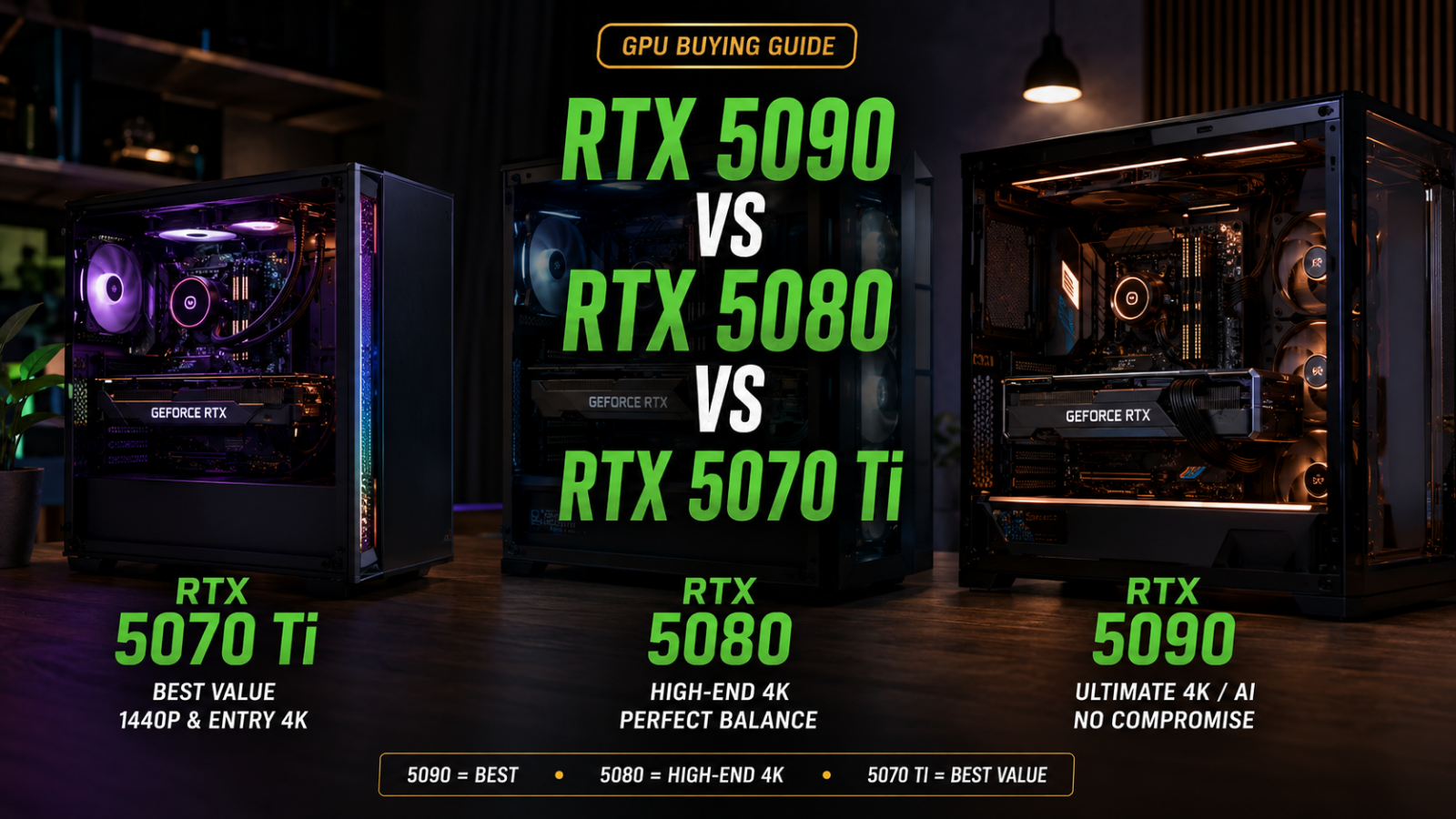
The RTX 5070 Ti is a good choice for a new 1440p or entry-level 4K gaming PC. But if someone already owns an RTX 4070 Ti Super, the upgrade is not very exciting unless they want RTX 50-specific features. For a deeper card-by-card breakdown, see our RTX 5090 vs 5080 vs 5070 Ti guide.
The RTX 40 SUPER Series Is Still A Strong Lineup

If you can find an RTX 4090, RTX 4080 Super, RTX 4070 Ti Super, or RTX 4070 Super at a reasonable price, these cards are still excellent gaming GPUs. They support DLSS 3, Frame Generation, ray tracing, NVENC streaming, and NVIDIA Studio acceleration. Many also benefit from continued DLSS 4.5 model improvements that NVIDIA has rolled out broadly.
DLSS 4.5 vs DLSS 3: This Is One of the Biggest Differences
One of the biggest reasons to consider RTX 50 Series is not just raw FPS. It is DLSS Multi Frame Generation.
DLSS 3 on RTX 40 Series introduced AI Frame Generation, which was a major feature for boosting perceived smoothness in supported games. NVIDIA says RTX 40 Series uses fourth-generation Tensor Cores and DLSS 3 to generate additional frames and improve performance.
RTX 50 Series goes further with DLSS 4 and DLSS 4.5 features. NVIDIA's DLSS page says DLSS Multi Frame Generation on RTX 50 Series can generate up to five frames per rendered frame, and Dynamic Multi Frame Generation can adjust the multiplier to maximize smoothness across games and scenes.
NVIDIA's DLSS 4.5 release notes also say the new model is available for RTX 40 and RTX 50 users, improving UI elements like mini maps and interface clarity, while the higher Multi Frame Generation modes are specifically tied to RTX 50 Series capability.
Important note
Frame generation does not replace real rendered FPS. It works best when the base FPS is already solid. It can make games feel much smoother on high-refresh displays, but for competitive gaming, real latency and base FPS still matter.
Ray Tracing and Path Tracing
RTX 50 Series is better positioned for heavy ray tracing and path tracing because of Blackwell's newer RT hardware, DLSS 4.5 features, and higher top-end performance.
NVIDIA says RTX 50 Series has fourth-generation Ray Tracing Cores built for "Mega Geometry" and path tracing with neural rendering.
However, the real-world performance difference depends on the card. The RTX 5090 has a clear ray tracing advantage over the RTX 4090. Tom's Hardware found the RTX 5090's ray tracing lead over the RTX 4090 increases to about 27% at 4K.
But lower in the stack, the improvement is less dramatic. TechSpot found the RTX 5080's ray tracing advantage over the RTX 4080 Super was modest, averaging about 5% faster at 1440p and 9% faster at 4K in its ray tracing summary.
GamerTech verdict
If you care about ray tracing or path tracing, NVIDIA is still the strongest ecosystem. But moving from RTX 40 to RTX 50 only makes sense if the specific card upgrade is meaningful.
VRAM: RTX 50 Series Wins at the Top
VRAM is one of the biggest practical reasons to consider RTX 50 Series, especially at the high end.
| GPU | VRAM |
|---|---|
| RTX 5090 | 32GB GDDR7 |
| RTX 4090 | 24GB GDDR6X |
| RTX 5080 | 16GB GDDR7 |
| RTX 4080 Super | 16GB GDDR6X |
| RTX 5070 Ti | 16GB GDDR7 |
| RTX 4070 Ti Super | 16GB GDDR6X |
| RTX 4070 Super | 12GB GDDR6X |
| RTX 5070 | 12GB GDDR7 |
For gaming, 16GB is still a strong place to be in 2026. For 4K gaming, high-resolution textures, heavy mods, AI workloads, rendering, and large creator projects, more VRAM can matter a lot.
The biggest jump is the RTX 5090 moving to 32GB, compared to the RTX 4090's 24GB. NVIDIA confirms the RTX 5090 has 32GB of GDDR7, while the RTX 4090 has 24GB of GDDR6X.
GamerTech verdict
For gaming only, 16GB is still very good. For AI, rendering, and workstation use, the RTX 5090's 32GB VRAM is a major advantage.
Power Consumption and Cooling

RTX 50 Series cards can be power-hungry, especially the RTX 5090. NVIDIA's official RTX 5090 spec lists 575W total graphics power, compared to the RTX 4090's 450W.
That matters for custom PC builds. A more powerful GPU requires:
- A high-quality power supply
- Proper 12V-2x6 / PCIe power handling
- Good cable clearance
- Proper case airflow
- GPU support bracket where needed
- Good thermal testing
- Proper fan curve tuning
This is one of the reasons custom builds matter. A powerful GPU is only as good as the system it is installed in.
Should You Upgrade From RTX 40 Series to RTX 50 Series?
Upgrade if you have RTX 4060, 4060 Ti, 4070, or older
If you are on an RTX 4060, RTX 4060 Ti, RTX 4070, RTX 30 Series, or older GPU, the RTX 50 Series can be a very meaningful upgrade.
You will get:
- Better ray tracing
- Better DLSS support
- Better AI features
- Better 1440p or 4K performance
- More future-ready features depending on the card
Maybe upgrade if you have RTX 4070 Super or RTX 4070 Ti
This depends on what you are upgrading to. Moving from RTX 4070 Super to RTX 5070 is not always exciting enough. But moving to RTX 5070 Ti, RTX 5080, or RTX 5090 can be meaningful depending on your monitor and games.
Usually do not upgrade if you have RTX 4070 Ti Super
The RTX 4070 Ti Super is still a strong 16GB GPU. The RTX 5070 Ti is faster, but not enough to make it an obvious upgrade for most people.
Usually do not upgrade if you have RTX 4080 Super
The RTX 4080 Super is still excellent. The RTX 5080 is faster, but the average improvement is not huge in traditional gaming.
Only upgrade RTX 4090 if you need RTX 5090 power
The RTX 4090 is still one of the strongest GPUs available. Upgrade to RTX 5090 only if you need the absolute best, 32GB VRAM, better AI performance, or maximum 4K/path-tracing performance.
Best Choice by Buyer Type
| Buyer Type | Best Recommendation |
|---|---|
| Building a new high-end gaming PC | RTX 5070 Ti or RTX 5080 |
| Building the best possible gaming PC | RTX 5090 |
| 1440p high-refresh gaming | RTX 5070 Ti |
| 4K gaming | RTX 5080 |
| 4K no-compromise gaming | RTX 5090 |
| Current RTX 4080 Super owner | Usually keep it |
| Current RTX 4090 owner | Keep it unless you need RTX 5090 |
| AI / local model user | RTX 5090 if budget allows |
| Creator / 3D rendering user | RTX 5080 or RTX 5090 |
| Best value buyer | Compare RTX 4070 Super / 4070 Ti Super deals vs RTX 5070 Ti |
Final Verdict: RTX 50 Series Is Better, But RTX 40 Series Is Not Dead
The RTX 50 Series is the better technology platform. It brings Blackwell architecture, GDDR7 on key models, stronger AI features, DLSS Multi Frame Generation, DLSS 4.5 features, Reflex 2, newer encoders, and better top-end performance.
But the RTX 40 Series is still very powerful. The RTX 4090, RTX 4080 Super, RTX 4070 Ti Super, and RTX 4070 Super are still excellent GPUs depending on price.
At GamerTech, we would summarize it like this:
- Best new high-end GPU: RTX 5090
- Best practical 4K gaming GPU: RTX 5080
- Best 1440p / value high-end GPU: RTX 5070 Ti
- Still worth keeping: RTX 4090, RTX 4080 Super, RTX 4070 Ti Super
- Worth upgrading from: RTX 4060, RTX 4060 Ti, RTX 4070, RTX 30 Series, and older cards
The smartest choice is not always the newest GPU. The smartest choice is the GPU that matches your monitor, games, budget, and workload.
If you are building a custom gaming PC in Canada, GamerTech can help you choose the right graphics card, CPU, cooling, power supply, case airflow, and storage setup so your system performs properly from day one.
FAQ
Is the RTX 50 Series better than RTX 40 Series?
Yes. RTX 50 Series is newer, faster overall, and has newer AI, DLSS, ray tracing, and Blackwell architecture features. But not every RTX 50 card is a huge upgrade over its RTX 40 equivalent.
Is RTX 5090 much better than RTX 4090?
The RTX 5090 is faster, especially at 4K and in AI/creator workloads. TechSpot measured around 27% more performance than RTX 4090 on average, with more VRAM and higher power consumption.
Is RTX 5080 worth upgrading from RTX 4080 Super?
Usually not for gaming alone. TechSpot found only a 4% average uplift at 1440p and about 9% better ray tracing performance at 4K with upscaling in its tests.
Is RTX 5070 Ti worth upgrading from RTX 4070 Ti Super?
Not for most people. The RTX 5070 Ti is faster, but TechSpot found only about 7% more performance at 1440p and 11% at 4K versus the RTX 4070 Ti Super.
Does RTX 50 Series have DLSS 4.5?
Yes. NVIDIA's RTX 50 Series platform includes DLSS 4.5 with Dynamic Multi Frame Generation on supported games and GPUs.
Does RTX 40 Series support DLSS 4.5?
Some DLSS 4.5 model improvements are available to RTX 40 and RTX 50 users, but the highest Multi Frame Generation features are tied to RTX 50 Series GPUs. NVIDIA says the new DLSS 4.5 model is available for RTX 40 and RTX 50 users, while RTX 50 Series powers the newer Multi Frame Generation modes.
Is RTX 40 Series still good in 2026?
Yes. High-end RTX 40 Series GPUs are still strong, especially RTX 4090, RTX 4080 Super, RTX 4070 Ti Super, and RTX 4070 Super.
Should I buy RTX 40 Series if it is cheaper?
Yes, if the price is good. A discounted RTX 4070 Super, RTX 4070 Ti Super, RTX 4080 Super, or RTX 4090 can still make a lot of sense depending on the build.
Which is better for 4K gaming: RTX 5080 or RTX 4080 Super?
The RTX 5080 is faster, but the RTX 4080 Super is still excellent. The better buy depends on real-world pricing.
Which is better for AI: RTX 5090 or RTX 4090?
The RTX 5090 is better for AI because it has more VRAM, newer Tensor Cores, and stronger Blackwell AI features. The RTX 4090 is still powerful, but the RTX 5090 is the better premium AI choice.
Build Your RTX Gaming PC With GamerTech
Every GamerTech build comes with a 1-year warranty, lifetime technical support, and free shipping to all Canadian provinces.
Build Your Own PC Pre-Built PCs Workstations
Call (905) 247-7085 · 10-470 North Rivermede Road, Vaughan, Ontario