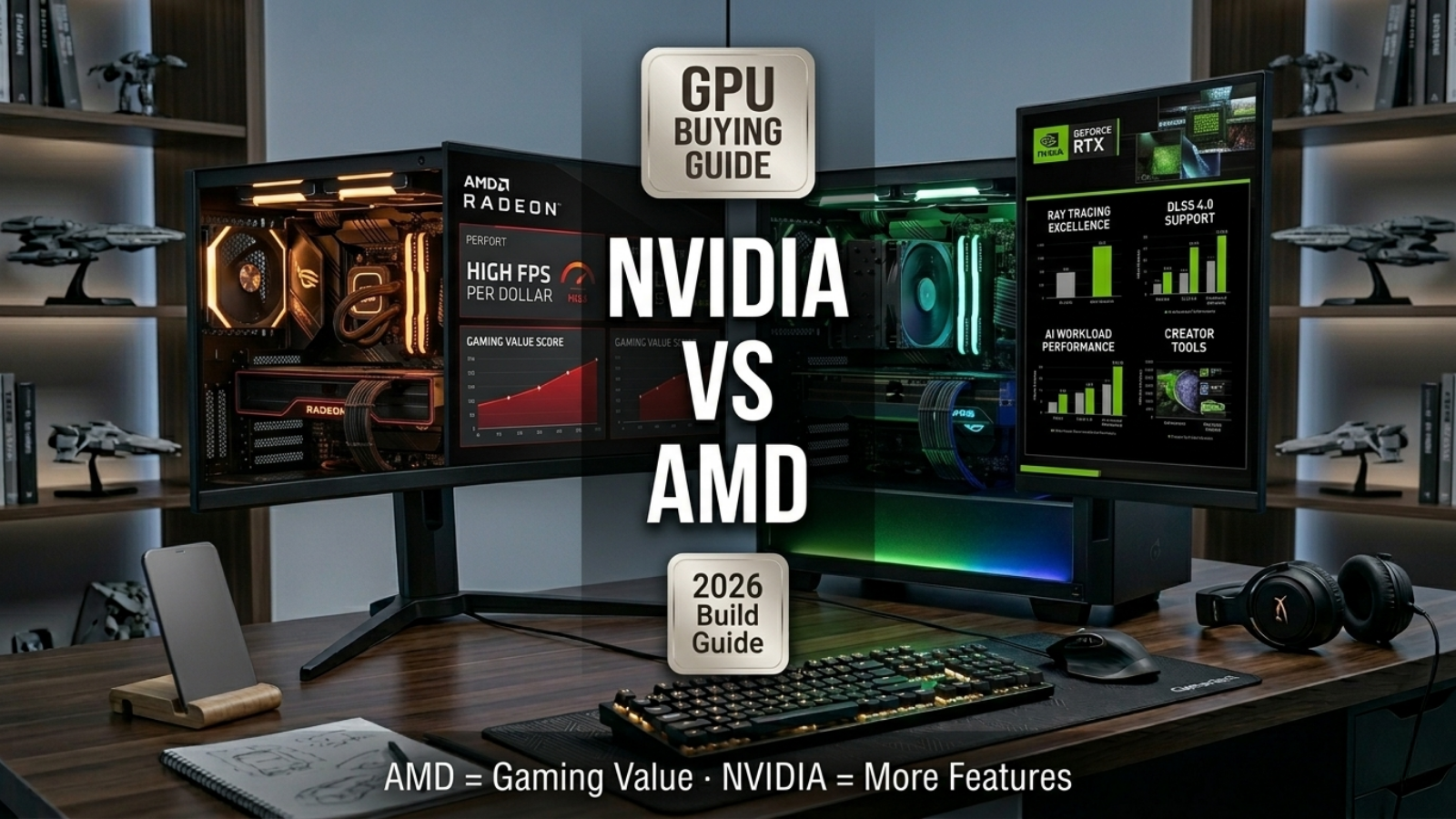

 AMD
AMDRadeon RX 9070 XTBest gaming value · $599 SEP
 NVIDIA
GeForce RTX 5070 TiBest features · $749 launch MSRP
Quick Answer
The AMD Radeon RX 9070 XT is usually the better value for pure gaming because it delivers very similar 1440p and 4K performance to the RTX 5070 Ti at a lower launch price. The NVIDIA RTX 5070 Ti is the better choice if you care more about ray tracing, DLSS, AI workloads, CUDA, streaming tools, and creator software support.
Two of the Best High-End Midrange GPUs in 2026
The AMD Radeon RX 9070 XT and NVIDIA GeForce RTX 5070 Ti are two of the most important GPUs for high-end gaming PCs right now.
Both cards target gamers who want strong 1440p ultra performance and capable 4K gaming without jumping all the way to an RTX 5080 or RTX 5090. Both cards also come with 16GB of VRAM, which is a good place to be for modern games, high-resolution textures, ray tracing, and future titles.
The important difference is this:
- The RX 9070 XT is AMD's value-focused RDNA 4 card.
- The RTX 5070 Ti is NVIDIA's more expensive Blackwell card with stronger AI, DLSS, ray tracing, and creator ecosystem support.
For a GamerTech customer, the right choice depends on what matters more: raw gaming value or NVIDIA features.
Specs Comparison
| GPU | AMD Radeon RX 9070 XT | NVIDIA RTX 5070 Ti |
|---|---|---|
| Architecture | AMD RDNA 4 | NVIDIA Blackwell |
| Compute / CUDA Cores | 4,096 stream processors | 8,960 CUDA cores |
| VRAM | 16GB GDDR6 | 16GB GDDR7 |
| Memory Bus | 256-bit | 256-bit |
| Memory Speed | Up to 20 Gbps | 28 Gbps (GDDR7) |
| Boost Clock | Up to 2,970 MHz | 2.45 GHz reference |
| Ray Tracing Hardware | 64 ray accelerators | 4th-gen RT cores |
| AI Hardware | 128 AI accelerators | 5th-gen Tensor cores |
| AI Performance | Up to 779 INT4 TOPS | 1,406 AI TOPS |
| Board Power | 304W | 300W |
| Recommended PSU | 750W | 750W |
| Launch Price | $599 USD SEP | $749 USD launch MSRP |
AMD's official RX 9070 XT specs list 64 compute units, 4,096 stream processors, 16GB of GDDR6 memory, a 256-bit memory interface, 64MB Infinity Cache, 304W typical board power, and a 750W minimum PSU recommendation. NVIDIA's official RTX 5070 Ti specs list 8,960 CUDA cores, 16GB of GDDR7 memory, a 256-bit memory interface, 1,406 AI TOPS, 133 ray tracing TFLOPS, 300W total graphics power, and a 750W required system power recommendation.
AMD announced the RX 9070 XT with a $599 USD suggested etail price, while NVIDIA's RTX 5070 Ti launched at $749 USD, making the AMD card $150 cheaper at official launch pricing.
Gaming Performance: They Are Very Close
For regular gaming performance, the RX 9070 XT and RTX 5070 Ti are extremely close.
The Verge tested the RX 9070 XT against the RTX 5070 Ti and found an average frame rate difference of less than 1% without upscaling across nine tested games. Their conclusion was that the differences mostly came down to individual games rather than one card clearly destroying the other.
TechSpot's later 22-game comparison found the RTX 5070 Ti was 5% faster than the RX 9070 XT with native rendering, but also noted that in a separate RX 9070 XT retest focused mostly on rasterized games, the RX 9070 XT was about 3% ahead of the RTX 5070 Ti.
That means the real-world answer is simple: these cards trade blows. In some games, the RTX 5070 Ti wins. In other games, the RX 9070 XT wins. Across a wide range of titles, they are close enough that price, features, and software support matter more than the average FPS difference.
1440p Gaming
For 1440p gaming, both cards are excellent.
The RX 9070 XT makes a lot of sense here because it gives you:
- 16GB VRAM
- Strong rasterized gaming performance
- Good 1440p ultra settings performance
- Lower official launch price than RTX 5070 Ti
- Standard 2x 8-pin power connectors
The RTX 5070 Ti also performs very well at 1440p, but its biggest advantage is not basic FPS. Its advantage is the NVIDIA feature stack: DLSS, ray tracing, Reflex, CUDA, NVIDIA Studio, NVENC, and stronger support in many creator and AI applications.
GamerTech 1440p Verdict
For most 1440p gamers, the RX 9070 XT is the better value if the price gap is meaningful. Choose the RTX 5070 Ti if the customer specifically wants NVIDIA features, better ray tracing, DLSS, streaming tools, or creator software support.
4K Gaming
For 4K gaming, both cards are capable, but neither should be treated like an RTX 5090-class GPU.
The RX 9070 XT performs surprisingly well at 4K. The Verge found that the RX 9070 XT came very close to AMD's previous flagship RX 7900 XTX, with the RX 7900 XTX less than 2% faster in their 4K and 1440p tests without upscaling.
The RTX 5070 Ti also performs well at 4K, especially when DLSS is available. NVIDIA's DLSS support is still a major advantage because more games support DLSS than FSR, and NVIDIA's RTX 5070 Ti supports DLSS 4, Frame Generation, Multi Frame Generation, Ray Reconstruction, Reflex 2, and NVIDIA Studio features.
GamerTech 4K Verdict
For 4K gaming, both are good, but the decision is more complicated:
- Choose RX 9070 XT if the customer wants the best value and mostly plays rasterized games.
- Choose RTX 5070 Ti if the customer plays ray-traced games, wants DLSS, or prefers NVIDIA's software ecosystem.
Ray Tracing: NVIDIA Still Has the Edge
AMD made major improvements with RDNA 4, and the RX 9070 XT is much better at ray tracing than older Radeon cards.
But NVIDIA still has the advantage in heavier ray tracing and path tracing scenarios.
The Verge found the RX 9070 XT was only 4% behind the RTX 5070 Ti in Metro Exodus Enhanced with ultra ray tracing, which is very competitive. But in Cyberpunk 2077 at 4K with ray tracing and upscaling, the RTX 5070 Ti was 16% ahead of the RX 9070 XT.
This is important because games like Cyberpunk 2077 are exactly the type of titles where NVIDIA tends to look strongest.
Ray Tracing Verdict
If the buyer plays mostly normal rasterized games, the RX 9070 XT is excellent.
If the buyer cares a lot about ray tracing, Cyberpunk-style visuals, path tracing, DLSS Ray Reconstruction, or maxed-out cinematic settings, the RTX 5070 Ti is the safer choice.
DLSS vs FSR: NVIDIA Has the Stronger Ecosystem
This is one of the biggest differences.
The RX 9070 XT supports FSR 4, AMD's newer AI-based upscaling technology for RDNA 4. The Verge notes that FSR 4 is exclusive to RX 9070-series cards and can work in games with FSR 3.1 integration through AMD software.
That is a big step forward for AMD. FSR 4 improves image quality and makes Radeon more competitive.
However, NVIDIA still has the stronger ecosystem because DLSS is supported in more games, and RTX 50 Series cards support DLSS 4 features including Super Resolution, DLAA, Ray Reconstruction, Frame Generation, and Multi Frame Generation.
The Verge also noted that NVIDIA can pull ahead in raw frame numbers when higher Multi Frame Generation modes are enabled, because AMD does not have the same equivalent for 3x and 4x frame generation.
Upscaling Verdict
- Best image/performance ecosystem: RTX 5070 Ti
- Most improved AMD upscaling: RX 9070 XT with FSR 4
- Best for games with DLSS support: RTX 5070 Ti
- Best value if you do not care about DLSS: RX 9070 XT
Streaming and Content Creation
The RTX 5070 Ti is the stronger choice for many creators.
NVIDIA has a major software advantage in:
- Adobe workflows
- Blender CUDA/OptiX rendering
- AI tools
- CUDA-based applications
- NVIDIA Studio drivers
- NVENC streaming and recording
- NVIDIA Broadcast
- Omniverse
- AI upscaling and creative tools
NVIDIA's RTX 5070 Ti includes 2x ninth-generation NVENC encoders, 1x sixth-generation NVDEC decoder, AV1 encode/decode support, NVIDIA Studio Drivers, and CUDA Capability 12.0.
AMD's RX 9070 XT is still usable for streaming, editing, and general content creation, but if the customer's software benefits from CUDA, NVIDIA is usually the safer recommendation.
Creator Verdict
For gaming only, the RX 9070 XT is very competitive.
For gaming plus editing, streaming, Blender, AI, or professional content work, the RTX 5070 Ti is usually the better all-around choice. See our workstation builds for creator-focused configurations.
AI Workloads
For AI workloads, NVIDIA has the advantage.
On paper, NVIDIA lists the RTX 5070 Ti at 1,406 AI TOPS, while AMD lists the RX 9070 XT at 779 INT4 TOPS.
More importantly, NVIDIA's CUDA ecosystem is still widely used in AI software. That matters for local AI tools, machine learning, Stable Diffusion workflows, AI video tools, and developer projects.
The Verge also found that in Procyon AI XL FP16 testing, the RX 9070 XT was around 20% behind the RTX 5070 in that AI workload, even though AMD's new card was much faster than older Radeon cards.
AI Verdict
If the customer says "gaming only," the RX 9070 XT is a great option.
If the customer says "AI, machine learning, Stable Diffusion, CUDA, rendering, Blender, or professional software," recommend the RTX 5070 Ti.
Power, Heat, and Build Compatibility
Both cards have similar power requirements.
AMD lists the RX 9070 XT at 304W typical board power with a 750W minimum PSU recommendation. NVIDIA lists the RTX 5070 Ti at 300W total graphics power with a 750W required system power recommendation.
The RX 9070 XT commonly uses 2x 8-pin PCIe power connectors, while NVIDIA's RTX 5070 Ti reference specification supports either 2x PCIe 8-pin cables through an adapter or a 300W-or-greater PCIe Gen 5 cable.
One practical note: card size depends heavily on the specific model. The Verge's XFX RX 9070 XT sample was a large 3.5-slot card, while the RTX 5070 Ti card they reviewed was 2.5 slots.
Build Verdict
Both cards need a quality PSU and good airflow. The RX 9070 XT may be easier for customers who prefer standard 8-pin power connectors, but the physical size of each model needs to be checked before building.
Pricing: This Is Where AMD Can Win
At official launch pricing, the RX 9070 XT was the better value.
AMD priced the RX 9070 XT at $599 USD, while the RTX 5070 Ti launched at $749 USD. That is a $150 USD difference for very similar gaming performance.
However, real-world GPU pricing changes constantly. As of late April 2026, PC Gamer's price tracking showed many GPUs selling above MSRP, with the RTX 5070 Ti listed around $990 USD and the RX 9070 XT around $670 USD in their tracked U.S. listings.
That is not Canadian pricing, and prices can change daily, but it shows the main point: if the RX 9070 XT is meaningfully cheaper, it is very hard to ignore.
Pricing Verdict
If the RX 9070 XT is $100–$250 cheaper than the RTX 5070 Ti, it is probably the better gaming value.
If the RTX 5070 Ti is close in price, NVIDIA's stronger feature set makes it easier to recommend.
Which GPU Should You Choose?
Choose the AMD Radeon RX 9070 XT if:
You want the best gaming value. The RX 9070 XT is the better choice if you:
- Mostly game at 1440p or 4K
- Care about raw FPS per dollar
- Do not rely heavily on CUDA
- Do not need NVIDIA Studio features
- Do not care much about heavy ray tracing
- Want 16GB VRAM at a lower price
- Prefer standard 8-pin power connectors
Choose the NVIDIA RTX 5070 Ti if:
You want the better all-around feature set. The RTX 5070 Ti is the better choice if you:
- Play ray-traced games often
- Want DLSS 4 and Multi Frame Generation
- Stream or record gameplay
- Use Blender, Adobe, AI tools, or CUDA-based software
- Want NVIDIA Studio drivers
- Care about AI acceleration
- Want the safer creator/workstation choice
Best Use Cases
| Use Case | Better Choice |
|---|---|
| 1440p gaming value | RX 9070 XT |
| 4K gaming value | RX 9070 XT |
| Ray tracing | RTX 5070 Ti |
| DLSS / frame generation | RTX 5070 Ti |
| FSR 4 value gaming | RX 9070 XT |
| Streaming | RTX 5070 Ti |
| Blender / CUDA rendering | RTX 5070 Ti |
| Local AI workloads | RTX 5070 Ti |
| Best FPS per dollar | RX 9070 XT |
| Best all-around features | RTX 5070 Ti |
Final Verdict
The AMD Radeon RX 9070 XT is one of AMD's strongest GPU releases in years. It gives buyers performance very close to the RTX 5070 Ti while launching at a much lower official price. For pure gaming, especially at 1440p and 4K, it is the better value if it is available at a fair price.
The NVIDIA RTX 5070 Ti is not the better value for every gamer, but it is the better feature card. It has stronger ray tracing support, DLSS 4, Multi Frame Generation, better AI acceleration, CUDA support, NVIDIA Studio drivers, NVENC, and a stronger creator ecosystem.
At GamerTech, our recommendation is simple:
- Best value for gaming: RX 9070 XT
- Best for ray tracing: RTX 5070 Ti
- Best for creators and AI: RTX 5070 Ti
- Best if pricing is close: RTX 5070 Ti
- Best if AMD is much cheaper: RX 9070 XT
The right GPU depends on the customer. If they mostly game, the RX 9070 XT can be the smarter buy. If they game, stream, edit, render, or use AI tools, the RTX 5070 Ti is usually the safer long-term choice.
If you are building a custom gaming PC in Canada, GamerTech can help you choose the right GPU, CPU, power supply, cooling, airflow, and storage setup so your system performs properly from day one.
FAQ
Is the RX 9070 XT better than the RTX 5070 Ti?
For pure gaming value, often yes. The RX 9070 XT performs very close to the RTX 5070 Ti and launched at a lower official price. But the RTX 5070 Ti has stronger ray tracing, DLSS, AI, creator, and CUDA support.
Is the RTX 5070 Ti faster than the RX 9070 XT?
Sometimes. TechSpot found the RTX 5070 Ti was 5% faster in a 22-game native rendering average, but also noted another raster-focused retest where the RX 9070 XT was about 3% faster. In practice, they are very close and trade wins depending on the game.
Which GPU is better for 1440p gaming?
The RX 9070 XT is usually the better value for 1440p gaming. The RTX 5070 Ti is better if the buyer cares more about DLSS, ray tracing, streaming, or NVIDIA software.
Which GPU is better for 4K gaming?
Both are capable 4K cards. The RX 9070 XT is better value, while the RTX 5070 Ti is better for DLSS-supported games and heavier ray tracing.
Which has more VRAM?
Both cards have 16GB of VRAM. The RX 9070 XT uses GDDR6, while the RTX 5070 Ti uses GDDR7.
Which GPU is better for ray tracing?
The RTX 5070 Ti is generally better for ray tracing, especially in demanding games like Cyberpunk 2077 with ray tracing and upscaling enabled.
Which GPU is better for streaming?
The RTX 5070 Ti is usually better for streaming because of NVIDIA's NVENC support, AV1 encode, and broader creator ecosystem.
Which GPU is better for AI?
The RTX 5070 Ti is better for AI because of NVIDIA's Tensor cores, higher listed AI TOPS, and CUDA software ecosystem.
Does the RX 9070 XT support FSR 4?
Yes. The RX 9070 XT supports FSR 4, AMD's newer AI-based upscaling technology for RDNA 4 GPUs.
Does the RTX 5070 Ti support DLSS 4?
Yes. NVIDIA lists DLSS 4 support for the RTX 5070 Ti, including Super Resolution, DLAA, Ray Reconstruction, Frame Generation, and Multi Frame Generation.
Build Your Gaming PC With GamerTech
Every GamerTech build comes with a 1-year warranty, lifetime technical support, and free shipping to all Canadian provinces.
Build Your Own PC Pre-Built PCs Workstations
Call (905) 247-7085 · 10-470 North Rivermede Road, Vaughan, Ontario